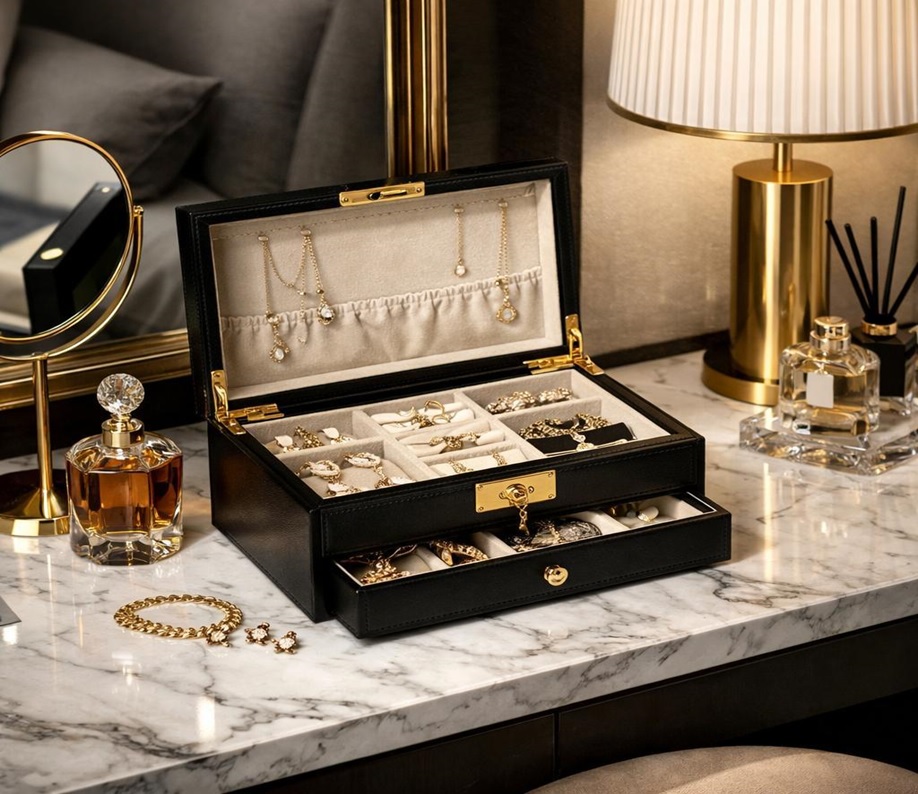
A jewelry collection rarely stays the same size.
A few everyday pieces can gradually become a mixture of rings, necklaces, bracelets, earrings, heirloom jewelry and watches. Some pieces are worn every week, while others may come out only for special occasions. Eventually, the question changes from where to put everything to how the collection should actually be organized and protected.
Good jewelry storage is not simply about having enough space. Different pieces have different physical requirements, and the most practical arrangement usually reflects how often they are worn, how delicate they are and how much protection they require.
For a smaller collection, a well-designed jewelry box may be entirely sufficient. As the collection grows, however, it often makes more sense to think about storage as a system rather than continuing to add boxes and drawers wherever space is available.
Start With the Collection You Actually Own
Before choosing new storage, it helps to look at the collection as a whole.
Jewelry has a habit of becoming distributed around the home without its owner really noticing. Everyday earrings may sit on a dressing table, necklaces in a jewelry box, watches in another case and less frequently worn pieces in their original packaging.
Bringing the collection together conceptually does not necessarily mean storing everything in one place. It means understanding what you own and what different pieces require.
Frequency of use is a useful starting point.
Jewelry worn several times a week should generally be easier to reach than pieces reserved for special occasions. Particularly valuable or sentimental items may need a different level of protection again.
The physical composition of the collection matters too.
A collection dominated by rings and earrings uses storage very differently from one containing long necklaces, large bracelets and several watches. Simply counting the number of pieces rarely tells you how much storage is actually required.
The collection should determine the storage, rather than being forced into whatever compartments happen to be available.
Give Individual Pieces Enough Space
Some of the easiest jewelry damage to avoid can happen while pieces are in storage.
Putting several items together in an open drawer may be convenient, but chains can become tangled and different surfaces can repeatedly come into contact with one another.
Separation helps.
Necklaces generally benefit from enough room to prevent chains from becoming intertwined. Rings and earrings are easier to organize when they have individual positions or small compartments. Bracelets need enough space that they are not compressed beneath other pieces.
Watches create a similar issue. Cases, bezels, bracelets and clasps can rub against neighboring objects when several watches are stored too closely together.
The storage environment matters as well.
For most collections, a stable indoor location away from unnecessary exposure is a sensible starting point. Direct sunlight may be unsuitable for some materials over extended periods, while excessive moisture or significant environmental fluctuations can also create problems for certain jewelry and accessories.
Different materials should not automatically be treated in exactly the same way. Pearls, gemstones, precious metals, leather and other materials can have different care requirements. Particularly delicate or unusual pieces should be stored according to the guidance appropriate to their materials.
The broader principle is simple: give individual pieces enough space and provide an environment appropriate for what is being stored.
Make Everyday Jewelry Easy to Put Away
Protection matters, but storage still has to work in everyday life.
Someone may own thirty pieces of jewelry while regularly wearing only six or seven. There is little practical reason for every item to have identical accessibility.
Thinking in terms of rotation can make storage more useful.
Everyday rings, earrings, bracelets and watches can occupy the easiest positions to reach. Jewelry worn only for particular occasions can remain in less frequently accessed compartments.
This has another benefit: it makes putting jewelry away easier.
Without a defined place for frequently worn pieces, they tend to accumulate on bedside tables, bathroom counters or dressing surfaces. A ring taken off at the end of the day may remain where it was placed simply because returning it to storage requires too much effort.
Over time, that increases the likelihood of pieces being misplaced or accidentally damaged.
A good storage arrangement should make returning jewelry to its proper place almost automatic.
That does not necessarily mean keeping everything visible. It means balancing organization with the way the collection is actually used.
Know When a Jewelry Box Is Reaching Its Limits
A jewelry box can serve a collection extremely well for years.
Its limitations tend to appear gradually.
The first sign may simply be capacity. Compartments become full, necklaces begin sharing spaces and watches are moved somewhere else because they no longer fit comfortably.
The collection can then become fragmented across several boxes and drawers.
For many people, adding another jewelry box is a perfectly reasonable solution. A larger cabinet may be useful for others.
As the financial or sentimental value of the collection increases, secure storage can also become a consideration.
There is no universal point at which a jewelry collection suddenly requires a safe. Someone with a small number of highly valuable or irreplaceable pieces may think about secure storage earlier than someone with a much larger collection of modestly valued jewelry.
The important distinction is that a jewelry box is primarily intended to organize and protect pieces during normal storage. Secure storage serves an additional purpose.
Collectors can therefore think about storage in different levels rather than assuming every piece requires the same solution.
Frequently worn jewelry may remain readily accessible, while heirloom pieces, higher-value items or jewelry used only occasionally can receive additional protection where appropriate.
Watches Can Change What the Collection Needs
For many collectors, watches sit alongside rings, bracelets and other jewelry, but they do not always have the same storage requirements.
Their physical dimensions are an obvious difference.
A large watch with a metal bracelet can occupy considerably more space than a ring or pair of earrings. Watches also benefit from dedicated positions that keep cases, bezels, bracelets and clasps from repeatedly contacting other objects.
Automatic watches introduce another consideration.
An automatic watch uses movement while being worn to help maintain its power reserve. If it remains unworn long enough, it will eventually stop. For many owners, this is entirely normal. The watch can simply be wound and reset when it returns to use.
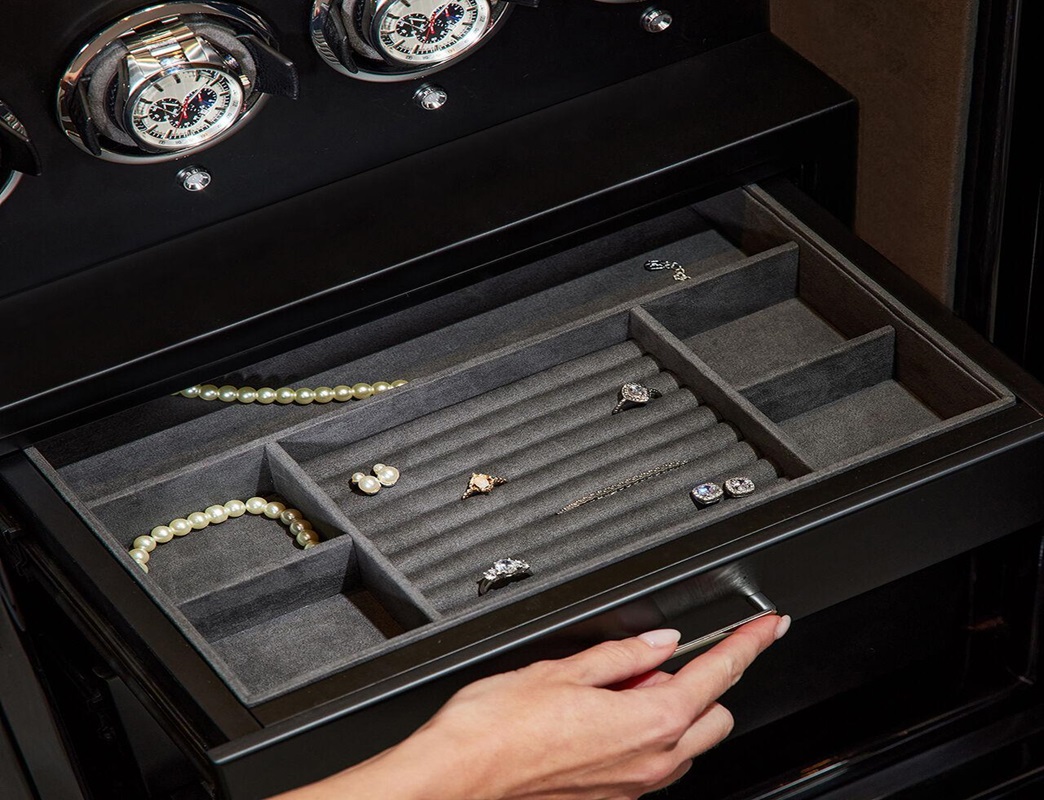
A collector who regularly rotates between several automatic watches may sometimes prefer to keep selected pieces running.
This means a mixed collection of fine jewelry and automatic watches can eventually require more than conventional jewelry compartments. Some collectors consider jewelry safes with watch winders, which combine secure jewelry storage with dedicated winding positions for selected automatic watches.
That does not mean every automatic watch requires a winder or that every jewelry collection needs this type of storage.
It simply demonstrates why mixed collections can benefit from storage designed around the objects inside them. Rings, necklaces and watches may belong to the same personal collection while still requiring different forms of organization.
Look Beyond the Capacity Number
Storage capacity is often described as a number: twelve watches, twenty rings or a certain number of compartments.
Those numbers can be useful, but they do not tell the entire story.
Two people can each own twenty pieces of jewelry and require completely different interiors.
One collection might consist mainly of rings and earrings. Another could contain necklaces, large bracelets and several watches. The second collection may require considerably more physical space even though the item count is identical.
Internal layout therefore matters as much as headline capacity.
Can necklaces be stored without becoming tangled? Are there enough small compartments for rings and earrings? Is there sufficient room for wider bracelets? If watches are included, are the positions appropriately sized?
Drawers can also help separate different categories instead of requiring every item to share the same type of compartment.
Some flexibility is useful too.
A storage system that is completely full on the day it is purchased leaves little room for the collection to change.
And collections usually do change.
Another ring arrives. A watch is added. A necklace requires more room than expected, and suddenly the last empty compartment is gone.
Leaving some adaptable space can be more valuable over time than maximizing the number of fixed compartments from the beginning.
Keep the Collection and Its Records Organized
As a jewelry collection grows, the pieces themselves are only part of what begins to accumulate.
Receipts, certificates, valuations, warranty information and service records can become important parts of the collection as well.
Keeping those records organized makes it easier to identify individual pieces and locate relevant information when it is needed.
Original packaging presents a separate challenge.
Ten jewelry or watch boxes can occupy considerably more space than the ten pieces they originally contained. There is often little reason for all of that packaging to remain in the same cabinet or storage area as the jewelry itself.
Original boxes can be organized separately while the collection remains in storage designed for everyday access and protection.
For more valuable pieces, photographs and basic identifying information can also be useful records to maintain.
Where insurance is relevant, requirements can vary between providers and policies, so collectors should confirm what documentation or valuations apply to their own circumstances.
The main objective is simply to prevent the information surrounding a collection from becoming as scattered as the jewelry once was.
Leave Room for the Collection to Change
Jewelry storage often feels spacious when it is first purchased.
Then the collection continues.
Tastes change, new pieces arrive and the balance between different types of jewelry can shift over time. Someone who currently owns mostly rings and earrings may later become interested in watches. Another collector may begin acquiring larger bracelets or more necklaces.
Heirloom pieces can arrive unexpectedly and introduce completely different storage requirements.
This is why some spare capacity is useful, particularly when choosing larger cabinets or secure storage that will be more difficult to replace than an ordinary jewelry box.
It does not mean buying the largest option available.
A flexible interior with room for several types of jewelry may be more useful than a much larger system filled with highly specific compartments that no longer suit the collection several years later.
The aim is not to predict exactly what the collection will look like in the future.
It is simply to avoid designing storage that is already at its limit today.
A growing jewelry collection is easier to enjoy when every piece has an appropriate place. Frequently worn items remain accessible, delicate pieces have enough separation, watches receive the space they need, and important records stay organized.
For some collectors, a jewelry box will continue to provide everything required. Others may eventually combine everyday storage with larger cabinets or secure storage for particular pieces.
There is no single arrangement that works for every collection.
The useful question is not how much jewelry can fit into a particular box or cabinet, but what the collection itself needs.
Jewelry is acquired to be worn and enjoyed. Good storage should protect that enjoyment while making the collection easier, rather than harder, to live with as it grows.
